
RALEIGH (February 26, 2026) – More than two years ago, the North Carolina Supreme Court heard arguments in the latest chapter of Leandro v. State, the landmark case affirming that every child in this state has a constitutional right to a sound, basic education.
Since then – silence. No ruling. No explanation. No clarity for the students, teachers and school districts whose futures hinge on the Court’s decision.
This delay is not normal. Court observers note that the justices typically issue opinions within a matter of weeks or months after oral arguments.
Yet the Leandro case has now languished for well over 730 days.1 During that time, the Court has released decisions in many other cases, some argued long after Leandro.
The message this sends is unmistakable: The constitutional rights of North Carolina’s children can wait.
Why? No one outside the Court knows. And that vacuum has been filled with speculation.
Many believe the Court’s Republican majority intends to reverse the lower court’s order requiring the state to fund a long‑promised education plan – and is simply waiting for a politically convenient moment.
Others suspect internal disagreement: Perhaps one or more justices are reluctant to overturn a constitutional mandate that has been reaffirmed for decades. Still others wonder whether political pressure is shaping the Court’s timeline.
These theories might or might not be true. What is true is that the Court has offered no justification for the unprecedented delay. And while the justices deliberate behind closed doors, the consequences outside those chambers are painfully real.
Charlotte public radio station WFAE reported this week that at least 215,000 students have graduated from North Carolina schools in the past two years alone, and as many as 20,000 students have dropped out.2
AN ENTIRE GENERATION of children has passed through North Carolina’s schools since the case was first filed by the state’s poorest school systems in 1994 – an astounding 32 years ago.
School districts across North Carolina continue to struggle with overcrowded classrooms, teacher shortages, outdated materials and buildings in disrepair.
The Comprehensive Remedial Plan – developed by experts and ordered by a former Supreme Court in 2022 to add billions for teacher pay, pre-K, better facilities and programs for students with disabilities3 – remains unfunded.
The constitutional promise made to our children remains unfulfilled.
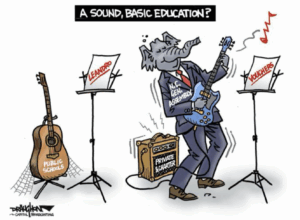
Editorial cartoon by Dennis Draughon, first featured on the Capitol Broadcasting Opinion page.
LAST WEEK a group of parents, educators and advocates held an event to criticize the Court’s sloth.
Durham parent Melissa Price Kromm said her daughter didn’t have a teacher for most of kindergarten or much of this year, which she attributed to chronic underfunding of the state’s public schools.
“Do you know how much a child grows in two years?” she asked.4
The main issue in this chapter of the case is whether the courts can order the expenditure of state dollars. Legislative “leaders” contend that under the state constitution, only the General Assembly can appropriate state funds.
Meanwhile, they can’t even get their act together to pass a state budget for the fiscal year that began last July – a fundamental responsibility of the legislature.5
And North Carolina once again ranks 50th among the states in “funding effort” – the percentage of its economy it devotes to K-12 public schools.6
The business community cares. A group of 55 business leaders in the state filed a “friend of the court” brief in the case where they backed implementation of the Comprehensive Remedial Plan as ordered by the Court in 2022.
Those business leaders “understand that our children and their educational attainment will determine North Carolina’s economic future. We fail to prepare them fully at our peril.”
“If the State continues to delay and defer the funding necessary to bring its educational efforts in compliance with what the Constitution demands, the strength of the North Carolina economy will recede along with the financial condition of its citizens.”7
LEANDRO has always been about more than legal arguments, though.
It is about whether the state will honor its most basic obligation to the next generation. Whether we believe in equal opportunity not just as a slogan, but as a constitutional guarantee. Whether we are willing to invest in the future of every child, not just those in wealthy communities.
The Court’s silence does not erase that obligation. It only deepens the harm.
North Carolina’s children cannot afford another year of waiting. The Court must issue its decision – whatever it might be – and allow the state to move forward.
Justice delayed is justice denied.
That’s not just a slogan. And nowhere is it more clear than in North Carolina’s classrooms.
It’s a student sitting in an overcrowded classroom. It’s a teacher stretched too thin to give every student the attention they deserve. It’s opportunities slipping away, not because students failed, but because the system failed them.
1 https://mailchi.mp/wfae/leandro-watch-its-been-732-days-without-a-ruling?e=9d69cce2ae.
2 https://mailchi.mp/wfae/leandro-watch-its-been-732-days-without-a-ruling?e=9d69cce2ae.
3 https://publicedworks.org/2022/11/at-last-supreme-court-orders-leandro-school-funds/
4 https://www.wral.com/news/education/parents-educators-as-for-leandro-ruling-two-years-later-february-2026/.
5 https://publicedworks.org/2026/02/is-the-nc-senate-letting-our-state-down/.
6 https://edlawcenter.org/research/making-the-grade-2025/.
7 Brief of North Carolina Business Leaders as Amici Curiae, Hoke County Board of Education, et al v. State of North Carolina, July 27, 2022, pp. 7-10.
Leave a Reply